Stench, p.1
Stench, page 1


Also by David Brock
The Fox Effect
Free Ride
The Republican Noise Machine
Blinded by the Right
This Is a Borzoi Book
Published by Alfred A. Knopf
Copyright © 2024 by David Brock
All rights reserved. Published in the United States by Alfred A. Knopf, a division of Penguin Random House LLC, New York, and distributed in Canada by Penguin Random House Canada Limited, Toronto.
www.aaknopf.com
Knopf, Borzoi Books, and the colophon are registered trademarks of Penguin Random House LLC.
Library of Congress Cataloging-in-Publication Data
Names: Brock, David, author.
Title: Stench : the making of the Thomas Court and the unmaking of America / David Brock.
Description: New York : Alfred A. Knopf, 2024. | Includes index.
Identifiers: LCCN 2024009528 | ISBN 9780593802144 (hardcover) | ISBN 9780593802151 (ebook)
Subjects: LCSH: United States. Supreme Court. | Political questions and judicial power—United States. | Political corruption—United States. | Thomas, Clarence, 1948– | Judges—Selection and appointment—United States. | Republican Party (U.S. : 1854– ) | Conservatives--United States. | Opus Dei (Society) | Secret societies—Religious aspects—Catholic Church.
Classification: LCC KF8742 .B735 2024 | DDC 347.73/26—dc23/eng/20240310
LC record available at https://lccn.loc.gov/2024009528
Ebook ISBN 9780593802151
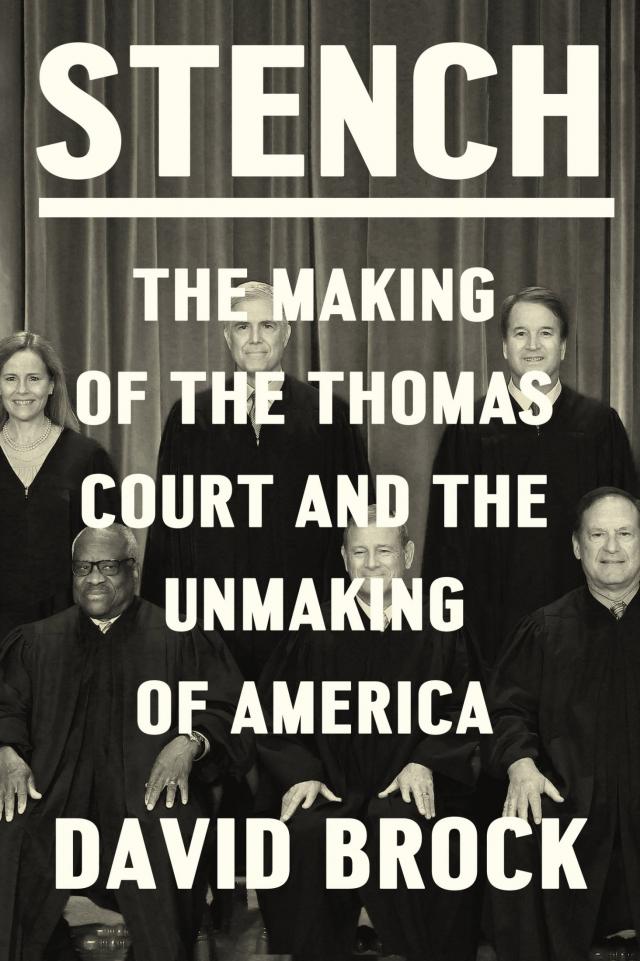
Cover photograph by Olivier Douliery/AFP/Getty Images
Cover design by Tyler Comrie
ep_prh_7.0_148168993_c0_r0
Contents
Prologue: April 1993
The Clarence Thomas Inner Circle and Me
Part 1: The Genesis of the Thomas Court
Chapter 1 October 1973: Nixon’s Revenge
Chapter 2 October 1960: Radical Catholics
Chapter 3 April 1982: The Federalist Society’s Revolution
Chapter 4 April 1986: When Clarence Met Ginni
Chapter 5 October 1987: The Deeper Meaning of “Borking”
Chapter 6 July 1991: Clarence Thomas, Revealed
Part 2: A Reactionary Movement Builds
Chapter 7 January 1993: The Right Sets Out to Get Bill Clinton
Chapter 8 August 1991: The Citizens United Filth Factory
Chapter 9 September 1994: Ken Starr’s Sidekick
Chapter 10 June 1997: John Eastman and the Growing Thomas Network
Chapter 11 December 2000: The Supreme Court Steals an Election
Chapter 12 October 2005: The Federalists Shoot Down Bush’s Choice
Chapter 13 January 2006: Scalito
Chapter 14 The Three Amigas: Ginni, Cleta, and Connie
Chapter 15 January 2010: Dark Money Unleashed
Part 3: Leo’s Time
Chapter 16 March 2016: The Art of the Deal
Chapter 17 April 2017: Gorsuch Gets Garland’s Seat
Chapter 18 October 2018: Kavanaugh Channels Thomas
Chapter 19 October 2020: The Handmaid
Part 4: A Crooked Court Cannot Escape True Reform
Chapter 20 June 2022: The Dobbs Earthquake and Beyond
Chapter 21 Real Reform Starts with Expanding the Supreme Court
Chapter 22 The Continuing Danger of Ginni Thomas
Chapter 23 Time to Impeach Clarence Thomas
Acknowledgments
Appendix
Notes
Index
_148168993_
Prologue: April 1993
The Clarence Thomas Inner Circle and Me
In 1993, you could argue, I was one of Clarence Thomas’s best friends. He and I never met, but we didn’t have to. His inner circle embraced me in my days as an attack journalist for a then-influential magazine called The American Spectator. They were there for me when I was researching and writing my book-length assault on Thomas accuser Anita Hill, published two years after her explosive 1991 testimony before the Senate Judiciary Committee accusing Thomas of sexual harassment. Hill’s televised appearance upended the confirmation hearings and very nearly derailed Thomas’s nomination to the Supreme Court. When my book The Real Anita Hill: The Untold Story was published and caused a media sensation, the Thomas inner circle—including his wife, Ginni—was there with me to celebrate our mutual triumph in undermining Hill and Thomas’s other accusers, and also, it’s fair to say, to gloat.
In retrospect, it seems to me more than passing strange that a book with so partisan an underlying purpose, no matter how adroitly argued, could have received such a warm reception in so many ostensibly critically minded quarters. Christopher Lehmann-Haupt, a respected daily reviewer in The New York Times, gushed about my “impressive investigative study,” and concluded that it was “extremely damaging to Anita Hill’s case.” A reviewer in the Sunday Times echoed that conclusion, and the Washington Post reviewer sanctioned the book as a “serious work of investigative journalism.” These credible voices were perhaps influenced following a careful rollout—first, excerpts on the Wall Street Journal editorial page, to confer the imprimatur of the conservative establishment to my arguments, then a George Will column in Newsweek in which the bow-tied pundit cheered as loudly for my book as he famously did for baseball, praising its “avalanche of evidence that Hill lied” and adding that it would surely be “persuasive to minds not sealed by the caulking of ideology.” Best of all, as I saw it at the time, Rush Limbaugh himself, then at or near the peak of his fame and influence, gave over the better part of three of his shows to read from my book out loud, word by word, to his massive radio audience. I had clearly triumphed in my mission to prop up Thomas’s reputation, at whatever cost, and halt a slide in the polls that showed public opinion moving from support of Thomas to siding with Hill. (According to Gallup, by the end of his confirmation hearings, fully 54 percent of Americans said they believed Thomas, versus 27 percent who said they believed Anita Hill; those numbers, by October 1992, showed 43 percent believed Hill, and only 39 percent believed Thomas.)
Then came a bombshell report in The New Yorker by two highly respected reporters, Jane Mayer and Jill Abramson, an “investigative review” that went to great lengths to discredit my book—and me. I flipped through the pages of their review in a kind of nervous fever. The truth hurts, and this was the truth, ladled out for me. “He is not an unbiased journalist, as he represents himself; he is a polemicist who writes,” the two said of me, accurately enough, I can say now.
I could have seized that moment to snap out of the mindset into which I had sunk in those years, an us-against-them tribalism in which pro-Thomas voices were ipso facto credible and worthy and anyone presenting the other side of the story so suspect as to not even warrant a hearing. Instead, as a natural fighter, a scrapper and a battler, I doubled down. Rather than accepting the truth of what Abramson and Mayer had reported, I would lie in the weeds and wait for my time to counterattack with all I had. What’s remarkable to me, looking back, was that obsessed as I was with fighting for my own reputation, stung by having been dubbed “sleaze” by one New York Times columnist, Anthony Lewis following the New Yorker broadside, I waited so long to ask myself hard questions about what the progression of events said about Clarence Thomas himself and his closest circle.
Looking back now, as demonstrated in the chapters that follow, I can state very clearly and forcefully that, based on information I was given once the hearings concluded and Thomas was confirmed to the Supreme Court, as well as subsequent revelations, I’m absolutely sure that Anita Hill told the truth and Thomas perjured himself to win Senate confirmation, which I would call the original sin of the far right’s court-packing scheme. Hill explained under oath in October 1991 to the Senate Judiciary Committee—and a live audience of tens of millions tuned into TV coverage—that Thomas harassed her many times during her two years of employment in Ronald Reagan’s Department of Education and then at the federal Equal Employment Opportunity Commission (EEOC). “He spoke about…such matters as women having sex with animals and films showing group sex or rape scenes,” she testified. Thomas often graphically described “his own sexual prowess” and the details of his anatomy. One of the films Thomas talked about, Hill said, was titled Long Dong Silver. Hill also recounted a bizarre instance in which Thomas asked, “Who put pubic hair on my Coke?”
Snap polls showed a country divided on the question of Hill’s veracity; I was one who initially believed her. Sitting in front of a TV screen at my office at The Washington Times, Rev. Sun Myung Moon’s right-wing answer to The Washington Post, I couldn’t imagine why this thirty-five-year-old law professor from Oklahoma would volunteer for the scrutiny of the klieg lights and make up such a vividly detailed account of sexual harassment. “Houston, we have a problem,” I thought.
I later learned that Thomas’s closest friends, who helped source The Real Anita Hill and assured me then of his complete innocence, didn’t believe him either. Mark Paoletta, a deputy counsel in the White House counsel’s office under President George H. W. Bush, where he worked on Thomas’s nomination, later told me he knew that Thomas had a penchant for the kind of raunchy pornography Hill was describing, a key proof point in her testimony. Though he denies it, the admission was shocking as it was the opposite of what Mark had s aid previously. Ricky Silberman, Thomas’s vice chair at the Equal Employment Opportunity Commission, which ironically enforced sexual harassment laws, later told me she had heard stories of Thomas hitting on female subordinates at the office.
“He did it, didn’t he?” she blurted out to me at one point after Mayer and Abramson weighed in.
In fact, I had heard that the Silbermans—Ricky and her husband, Laurence, who sat on the D.C. Circuit Court with Thomas—had such grave doubts about Thomas’s plan to flatly deny Hill’s allegations that they had quietly pulled Thomas aside and counseled him to withdraw his nomination. They didn’t think he could lie his way through this one and survive. Thomas apparently never forgave them for their blunt honesty. And yet, the conservative power couple had insisted to me that Thomas was completely innocent.
One of the most insidious realities of what transpired next was not only that Thomas lied, but that he caused so many others to lie for him. The Thomas circle launched an unprecedented and truly evil smear campaign against the victim of Thomas’s predations. Hill was portrayed not only as a bald-faced liar with a left-wing political agenda but also as mentally ill and even a sex pervert herself. In his testimony, Thomas inverted the story, portraying himself as victim, claiming he was being subjected to a “high-tech lynching for uppity blacks” by white liberals who were trying to block a Black conservative from taking a seat on the nation’s highest court.
Orrin Hatch, the Utah Republican who was the lead defender of Thomas on the Senate Judiciary Committee, suggested preposterously that Hill had lifted the anecdote about pubic hair on a Coke from the horror movie The Exorcist, which had contained a reference to “an alien pubic hair floating around in my gin.” Alan Simpson, the GOP senator from Wyoming, was next up to bat. “And now, I really am getting stuff in over the transom about Professor Hill,” Simpson said, menacingly. “I have got letters hanging out of my pockets. I have got faxes. I have got statements from her former law professors, statements from people who know her, statements from Tulsa, saying ‘Watch out for this woman!’ But nobody has the guts to say that because it gets all tangled up in this sexual harassment crap.”
Sexual harassment crap? These were my allies.
The Thomas-Hill case is often cast as a “he-said, she-said,” but it’s not. Three female witnesses waited in the wings to support Hill’s story and her credibility, including Angela Wright, who had worked with Thomas at the EEOC and had corroborative testimony. They were not called, due to what the Los Angeles Times described as a private compromise deal between Republicans and the Judiciary Committee chairman, Joe Biden. Wright was interviewed by committee lawyers for the record, but she was not permitted to tell her story to the public; she was kept off national television. Biden apparently saw himself not as a partisan Democrat prosecuting a case but as a neutral arbiter of fact; as head of the committee, his role was to conduct a fair hearing—even though Republicans like Hatch and Simpson adopted their usual approach of all-out combat and scorched-earth tactics.
On the morning of October 10, 1991, with the Thomas hearings scheduled to open the next day, Senate staff members from both parties interviewed Wright by telephone. She described several instances in which Thomas had made sexual remarks to her and said that he had once stopped by her apartment uninvited and stayed until past midnight. She claimed that he pressured her to go out with him and once asked her breast size. “You look good and you’re going to be dating me,” she said Thomas told her in 1984, soon after he had hired her as director of media relations at the EEOC. Wright came across as articulate and credible and was firm in relaying her certainty that Hill was telling the truth, based on her own experiences with Thomas. The committee released the Wright statement late the night before the Thomas vote so that it would attract little attention. After extensive debate, the Senate confirmed Thomas by a vote of 52–48, the narrowest margin since the nineteenth century.
In the wake of the hearings, Thomas was deeply wounded and his reputation sullied; his supporters were angry and out for blood. Thomas could be on the court for decades, they knew, and there was his legacy to think about. Hill’s testimony had created a political backlash that threatened to elect a wave of Democratic women and derail the Bush presidency. That was when a right-wing tobacco heiress from North Carolina made a telephone call to an editor at The American Spectator, a small right-wing magazine publishing some of my freelance writing at the time. Elizabeth Brady Lurie wanted to donate money for an investigation of Anita Hill. I got the assignment. My article, “The Real Anita Hill,” the one in which I called Hill “a bit nutty and a bit slutty,” caused a sensation in right-wing circles. Soon I had a contract for a full-length exposé of Hill to be published by a conservative imprint, the Free Press, part of an established and respected mainstream publishing house, Simon & Schuster.
I convinced myself I was telling the true story, but I relied solely on the Thomas camp for my research and interviews. I wholly adopted their point of view. The Republicans pulled out all the stops to help me, providing me with an “erotomania” diagnosis for Hill that some random psychologist had sent in to the committee; an affidavit filed by former law students of Hill’s who attested—unbelievably—to Hill having inserted pubic hairs into their exam papers; and even the FBI background report on Angela Wright, the leaking of which was a federal crime. There wasn’t anything in the Wright file that at all impeached her credibility, though there was a stray account of a neighbor who had allegedly seen Wright vacuuming her house in the nude. What? It meant nothing, but I tossed it in for effect. That’s the kind of book it was.
That was tame compared with what came next. The success of The Real Anita Hill cast me into the role of foremost defender of the biggest hero on the American right. I embraced it. Two years later, in January 1994, when Mayer and Abramson published their own book, Strange Justice: The Selling of Clarence Thomas, which provided fresh reporting showing that Thomas had certainly lied under oath, I was ready. I had not forgotten the two journalists’ epic takedown of my book The Real Anita Hill, showing all its many flaws in high relief, and I wanted revenge.
The duo had produced a new witness, Kaye Savage, a onetime friend of Thomas’s who said that when she visited Thomas’s apartment, she had been taken aback by graphic porn pinups he had plastered all over his walls. To undermine Savage, I called Mark Paoletta, by now a close friend of both mine and Thomas’s.
“Savage is a problem,” I told Mark.
He called Thomas about the “problem,” and Thomas passed on to me negative personal information about Savage that he said had come up in her divorce proceedings. I should have been appalled. I should have recoiled. I should have instantly extricated myself from playing any role in such garbage tactics. Instead, in menacing tones, I confronted Savage with the information. I hinted darkly that I would publish it if she didn’t recant her story. In effect, I was now engaged in blackmailing sources and terrorizing innocent women in the cause of defending Clarence Thomas against testimony that I knew was likely true. When I published my review of Strange Justice in The American Spectator, I smeared Savage, Mayer, and Abramson and called them liars. But I knew better. This time I was the liar.
I spent years after that working on a brutally honest and self-critical book, Blinded by the Right: The Conscience of an Ex-Conservative, in which I came clean and repudiated my years as a tool of radical-right-wing interests. I hated writing that book. That old line about writing being easy, you just open a vein, never hit home harder. The book was “the result of harrowing experience,” as former New Republic editor Hendrik Hertzberg put it in a long, favorable review in The New Yorker. “What drove Brock was the wrongness of what he did, not of what he thought,” Hertzberg wrote. “As a frontline machine gunner in the Washington scandal wars of the nineteen-nineties, Brock inflicted heavy political casualties. But his own wounds came mostly from friendly fire, and many of these, he eventually realized, were self-inflicted. Blinded by the Right…is the story of a change of heart, not of mind.”
When that painfully honest book hit the New York Times bestseller list in 2002, it energized me on a crusade to help the Democratic cause. Working with Bill and Hillary Clinton, I founded the watchdog Media Matters for America, widely hailed in Democratic Party circles as a game-changer, which put in place the first system to monitor, analyze, and expose right-wing disinformation in the media. Also revolutionary, in tame Democratic Party circles, we used the word “lie” to describe what the other side routinely did. I knew it because I had lived it. Later I also founded the oppo-research powerhouse American Bridge, responsible for upending countless campaigns with our exposés on GOP candidates. I morphed into an effective operator supporting Democratic Party causes and candidates in the country, working to counter the influence of the organized right in our politics and culture.