

Full immersion, p.1
Full Immersion, page 1


PRAISE FOR GEMMA AMOR
“Astonishing and totally unique, Gemma Amor writes so fearlessly that it feels as if she were baring her soul in Full Immersion. An intricately crafted and superbly rendered vision of horror-fantasy from one of the genre’s most brilliant and devastating voices.”
Eric LaRocca, Bram Stoker Award nominated author of Things Have Gotten Worse Since We Last Spoke
“A deep dive into the horrors of depression, Full Immersion takes readers on a harrowing journey into the character of Magpie, a woman grappling with a horrifying history she can barely remember, now lost within herself. There, a host of terrors play out in unexpected, gruesome ways. Told through duelling POVs, Ms. Amor’s writing is tense and sharp, reminiscent of Kealan Patrick Burke, Jeanette Winterson and Charlotte Perkins Gilman. Fans of both psychological and body horror will find much to enjoy here!”
D.K. Stone, author of Fall Of Night
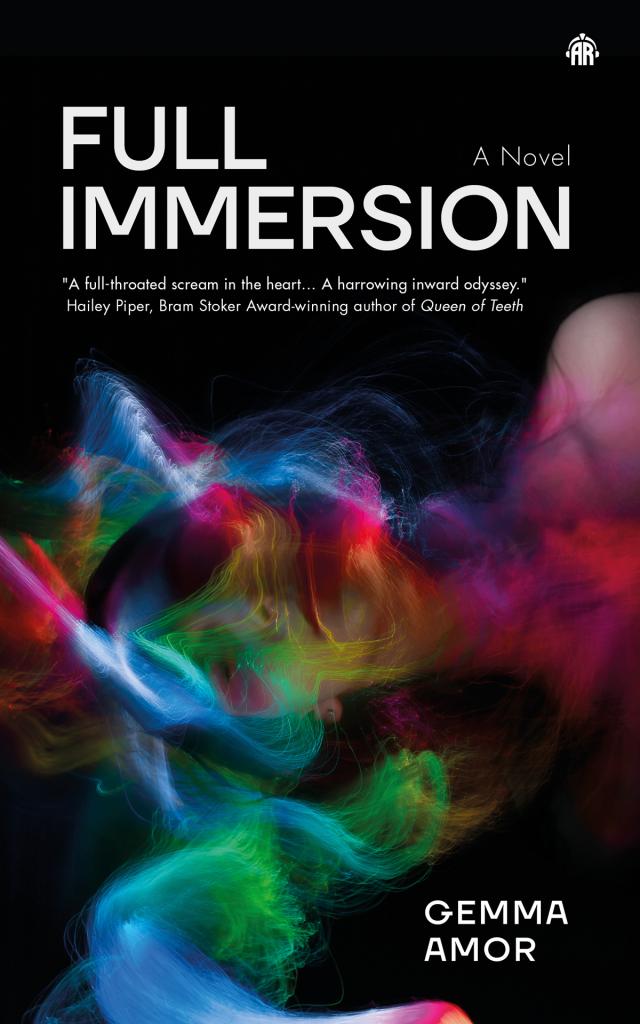
“Powered by dread from the very beginning, Full Immersion is a full-throated scream in the heart. Gemma Amor wields an ever-tightening emotional vice, constantly questioning and challenging the malevolent unreality we accept as our lives. A harrowing inward odyssey.”
Hailey Piper, Bram Stoker Award winning author of Queen of Teeth
“Raw, personal, confrontational, and timely, Gemma Amor bares her soul in full for a book that will rock you to your core. Charting a metaphysical landscape of pain and real suffering, Full Immersion is nothing less than a klaxon call confirming one of the most daring and fearless voices in contemporary fiction.”
Kealan Patrick Burke, Bram Stoker Award-winning author of Kin and Sour Candy
“With Full Immersion, Gemma Amor offers you an incredible journey into the dangers and possibilities of the human mind. It’s shocking and unnerving and heartbreaking and, ultimately, hopeful in a way that makes you want to jump for joy. It will reawaken you to the possibilities – and depths – of our souls.”
Nick Kolakowski, author of Absolute Unit and Boise Longpig Hunting Club
“Gemma Amor’s raw, dreamlike novel, Full Immersion, crept under my skin in the most delicious way. A modern-day fairy tale where the princess must save herself, this book will unnerve you and break your heart. An important, timely story.”
Meagan Jennett, author of You Know Her
“All of Gemma’s work is vivid and visceral, but Full Immersion will invade every space of your heart and mind. The hurt is terrifying as it jumps off the page to create haunting images of catastrophic proportions. If you are not a Gemma fan already then you will be after this one. I felt every word.”
V. Castro, Bram Stoker Award nominated author of Goddess of Filth
“The bravest book you’ll read all year. Harrowing, yes, but necessarily so. As empowering as it is powerful. Not only does the book benefit a crucial cause, the stories are extraordinary, written by more than a dozen paramount voices in horror. Sometimes a book illuminates as it entertains; We Are Wolves is that rare find.”
Josh Malerman, New York Times best selling author of Bird Box and Malorie, on We Are Wolves
“It pulls no punches, asks for no quarter, and will leave you breathless. I loved it.”
Brian Keene, best-selling author and World Horror Grandmaster Award-winner, on We Are Wolves
BY THE SAME AUTHOR
Dear Laura
White Pines
Girl on Fire
Six Rooms
Cruel Works of Nature
These Wounds We Make
Grief is a False God
We are Wolves
(Editor, with Cina Pelayo and Laurel Hightower)
ANGRY ROBOT
An imprint of Watkins Media Ltd
Unit 11, Shepperton House
89 Shepperton Road
London N1 3DF
UK
angryrobotbooks.com
twitter.com/angryrobotbooks
Life after Life
An Angry Robot paperback original, 2022
Copyright © Gemma Amor 2022
Cover by Francesca Corsini
Edited by Eleanor Teasdale and Andrew Hook
Set in Meridien
All rights reserved. Gemma Amor asserts the moral right to be identified as the author of this work. A catalogue record for this book is available from the British Library.
This novel is entirely a work of fiction. Names, characters, places, and incidents are the products of the author’s imagination or are used fictitiously. Any resemblance to actual events, locales, organizations or persons, living or dead, is entirely coincidental.
Sales of this book without a front cover may be unauthorized. If this book is coverless, it may have been reported to the publisher as “unsold and destroyed” and neither the author nor the publisher may have received payment for it.
Angry Robot and the Angry Robot icon are registered trademarks of Watkins Media Ltd.
ISBN 978 0 85766 981 0
Ebook ISBN 978 0 85766 984 1
Printed and bound in the United Kingdom by TJ Books Ltd.
9 8 7 6 5 4 3 2 1
This book is for those who kept me here when I wanted to leave, and for those who gave me a reason to stay. For those who fought alongside me, dragged me up the mountain, helped me draw a line in the sand. Thank you.
It is also for those who solved their own mysteries, but most especially, this book is for those who could not.
It is for The Kid, who I love, eternally, without bounds.
And lastly, this book is for me.
TABLE OF CONTENTS
Foreword
1 Words on a Page
2 Voyeurs
3 My Body
4 Debt
5 Collection
6 Fool’s Gold
7 The Briefcase
8 Three Women in a Photograph
9 Daffodil Yellow Walls
10 Bingo
11 My New Friend
12 The Boat
13 The Room Behind The Red Door
14 A Notebook
15 A Little Bag of Powder
16 Choices
17 Command Prompt
18 Potential
19 The Meadow
20 Saliency
21 Yellow Ribbon
22 Easter Island
23 Freedom
24 Wet
25 Surgery/Birth
26 Lightbox
27 The Root Cause
28 Wrong Psych
29 False Narrative
30 Intrusive Thoughts
31 Invitation
32 The Well
33 End Of Evans
34 Out, Out
35 Full Immersion
36 Empty
37 The Bridge
38 A Beehive
39 A Single Lock of Hair
40 Finale
Resource
Acknowledgement
FOREWORD
How much is a woman’s life worth, when you think about it? When it comes down to the nuts and bolts, the cowrie shells, the leather bank notes. I think about this a lot, for reasons that will be clearer once you’ve read this book. I think about the value we place on human life. I think about how willing we are sometimes to let that life fall to the wayside, as if it were no more important than a broken-down car. When we malfunction, our value decreases in the eyes of society. Our peers, colleagues, government, and even sometimes our friends and lovers struggle to see our substance beneath the cracks. Never was this made more apparent than when I gave birth to my son, and later became quite unwell, mentally. I felt people around me withdraw as if stung. I felt like dirty goods, not to be touched. In turn, this made me feel doubly unqualified and unfit to be a mother, which was silly, when you think about it, because the only opinion I should have cared about was my son’s. ‘We just want you to get better,’ people said, as if the ‘unbetter’ version of me was now untenable. I think in hindsight many of them were genuine about this, and equally afraid of saying or doing something that might make me worse, but still. It felt like a strange, cosmic punishment, the loneliness that ensued. As if I was suddenly invisible to many who had seen me clearly before. I became staggeringly obscure. Like a ghost pounding on the walls. Yet my shine was still there. All it took was for someone to understand that a broken state need not be permanent, need not be repulsive, and maybe help a little, thumb some of the dirt away, expose my natural hue.
That person, first and foremost, had to be me. I’m not saying I didn’t need help. I did, but I found it difficult to ask for. In time, I was able to lean upon my husband. My therapist. My doctor, who didn’t dismiss my concerns out of hand (what a world, where I feel grateful for the simple act of being taken seriously). But my true champion, my white knight, my hero, in the end, turned out to be myself. I had to figure out how much my own life was worth, flaws and all. It was a slow process. A large part of it revolved around me sitting in a café after the school run, writing this novel. I wrote it, and it saved my life. I wrote it, and hoped that in the future, my son would know me better. I don’t want him to feel responsible for anything that happened while I was sick, but I know that children take a lot upon themselves. I thought long and hard about whether or not I wanted to expose myself by getting this book published, but anyone who knows me knows that I am not ashamed or afraid of writing painful truths. I’m aware that judgement often follows. But by putting it all down like this, I become more real in my own eyes, remind myself of my worth. The value of a woman’s life, measured by her bodyweight in words. And writing this story showed me something. It showed me that broken, chipped, scarred, cracked, flawed… none of this means less valuable. Coins minted with mistakes are often more valued by collectors. Inclusions in gemstones remind us that nature puts her own, unique signature into something: individuality. Michelangelo’s statue of David is missing a muscle between his spine and shoulder blade, owing to an imperfection in the marble. Being broken didn’t make me less valuable. If you’re feeling cracked down the middle, I would like you to remember that.
Anyway, for readers who are new here: I like to write forewords. Partly in defiance of the foreword naysayers, but mostly because I like to let folks know what they are in for when it comes to certain topics, themes and content they might find distressing. I feel strongly about letting people decide for themselves whether or not to engage with this stuff, so here goes: this novel deals heavily with themes of suicidal ideation, intrusive thoughts, post-natal depression, implied harm to a child, and descriptions of childbirth that some of you may find a little challenging. I shall say no more than this: Full Immersion was my first completed novel, and it remains, to date, my most raw, my most painful, and yet my most hopeful.
At the back of this book I’ve included a list of charities and organisations that may be helpful to anyone fighting a similar battle. There are some brilliant people and resources out there who can help you see your incredible worth through the fog of despair.
In the meantime, I want you to know: I see you, too. I see that shine. You aren’t broken, not to me. You’re brimming with potential, with hope, with wonderful things to come. You’re riddled with wonderful cracks, anomalies, quirks, idiosyncrasies. Your babies love you, and I think you’re incredible, and your worth simply too great to quantify.
1
WORDS ON A PAGE
To: The Department of Virtual and Experimental Therapy
University of Bristol
One Cathedral Square
College Green
Bristol
JUNE 26TH, 2019
Dear Sirs,
It has taken me six months to write this letter.
You should know I have tried everything else. I have tried medication, counselling, cognitive reprogramming exercises. I do yoga, and I paint. I take long walks. I sleep for eight hours a day, read self-help books, listen to soothing podcasts and ambient, lyric-less music. I have a therapy app on my phone, in fact I have three. I masturbate frequently and stay hydrated.
None of it works.
Because I still wake up every single day without exception and think about throwing myself off the Bristol suspension bridge.
It’s not an idle thought, nor a romantic one. I don’t wake up and wonder what it feels like to fly, or how the cold metal suspender cables will feel in my hands as I climb up above the bridge deck, or whether the impact of hitting the river will kill me before I drown, pushing my bones out through my skin, snapping my neck. It isn’t a dramatic response to stress, or a morbid fascination, or an indeterminate sense of melancholy, or even a cry for help (unlike this letter).
It’s a compulsion. It’s like I am being called. It’s relentless.
And I just don’t know why.
That’s why I need your help.
I know about your department and your Virtual Experimental Therapy programme. My husband keeps up with that sort of thing – he has a vested interest now, I imagine. I first read about you in a magazine of his, then did some digging. I understand that you are widely considered “unorthodox”.
Well, maybe unorthodox is exactly what I need, because Christ knows nothing else is working.
I understand you accept a limited number of patients on a deferred payment plan basis. I need you to consider this letter as my application to be one of those patients. You see, the thing about my condition is that I can’t hold down a steady job. This means I have no money. I can’t ask my husband for any more help; I have taken enough from him already.
But without money, I can’t afford your services.
So again, these words:
Help me.
Words are funny, aren’t they? They’re like little pieces of yourself, given away. Like the words in this letter. Are they persuasive enough? I hope so. I was a writer, in my better days. I don’t really know what I am anymore. A shadow, perhaps. An echo. An impression of a person, rather than the whole.
I’m drunk, writing this. Ten minutes before putting pen to paper I chased the booze with some of those pills various doctors keep giving me, the ones that don’t help much at all. I keep telling them, these don’t help, but all I end up with is a fresh prescription, a different type of pill. If you listen carefully enough, you might hear me rattle, I am so full.
But you don’t want to hear all that.
There is a point to this.
The point is “The Question”.
And “The Question” is always the same. People always want to know the same thing.
“Why do you want to kill yourself?” they ask.
And I never know how to answer.
Because leaving everything behind would only make sense if there was a reason for me to want to do so, surely.
“Did something happen to you?”
This is The Other Question that people always ask. They’re also looking for “A Reason”, an exposition. Maybe a trauma, an event, as described, something that perverts my brain away from its vital task of the everyday, and makes it weaker, and tired, and colours everything grey.
And this question is actually a “Good Question”.
Because, sure, lots of things have happened to me. Things I can consciously recall. Bad things. Good things. Awful things, surmountable things, shameful things.
But what if something happened to me that I can’t recall? My memory feels like a beach bathed in fog.
Or worse, what if I did something? Something wrong? Something bad? Something I’ve forgotten. What if there is a dark secret lurking in my head?
And if there were, could you help me uncover it? Your programme seems ideally placed to do so.
If there is no grand, insidious secret, if it turns out that life is just a steady trickle of events, a slow and creeping succession of little traumas, a collection of hurt, if you will, then your treatment may also help me come to terms with that.
Either way, my mind is being eaten away steadily. In the better hours, I can just about remember my name, and that I am married, and that I used to be a Mother, have a life. Other times, the words escape me. Because words are tricky, aren’t they? In the time it has taken you to read this far, I have told you that I no longer want to live. Perhaps I’m already dead. Who knows? You can’t see me, you can only see my words, like footprints left behind in the sand.
Do you believe me? Why would you? If I was serious, then I wouldn’t be sending this letter, would I?
God, I’m tired of myself.
I’m writing with no expectations, only desperation. Words, marching quickly across the white page like dutiful ants going about their business, and that business is this: alive, or dead.
Heads, or tails. Black, or white.
Seems simple, doesn’t it?
It isn’t.
Please help me.
Yours, with hope,
M
2
VOYEURS
In a dark, modestly furnished room that smells of hot coffee and hot metal and hot plastic, two technicians sit side by side, crammed up against the far wall. They are pinned in place by a vast array of electronics and equipment: wires, screens of varying sizes, VR headsets, headset base stations, a projector, routers, laptops, a scanner or two, mounted panels with flashing, multi-coloured LEDs, keyboards, speakers, wireless controllers, a strange, square, multi-parameter monitor with a built-in printer, and other things that are difficult to make out in the low light. It’s a mess, but one the pair seem comfortable with. On three walls of the room, polished whiteboards hang, graffitied with scribbles and doodles. On the last wall, closest to where the Techs and their equipment huddle, a large expanse of glass stretches from corner to corner: a window, or, more precisely, a reciprocal mirror, reflective on one side, transparent on the other.
The team of two speak in a hushed, absent-minded way to each other as they fiddle with their gear, fully absorbed in their work, wiring themselves up, slotting headphones over their ears, plugging themselves in with the practiced seriousness of astronauts preparing for launch. They have an important task to perform. A new project. They are the watchers. The moderators, the Behind the Scenes team.






