

Congratulations the best.., p.1
Congratulations, the Best Is Over!, page 1


This is a work of nonfiction. Some names and identifying details have been changed.
Copyright © 2023 by R. Eric Thomas
All rights reserved.
Published in the United States by Ballantine Books, an imprint of Random House, a division of Penguin Random House LLC, New York.
Ballantine is a registered trademark and the colophon is a trademark of Penguin Random House LLC.
Library of Congress Cataloging-in-Publication Data
Names: Thomas, R. Eric, author.
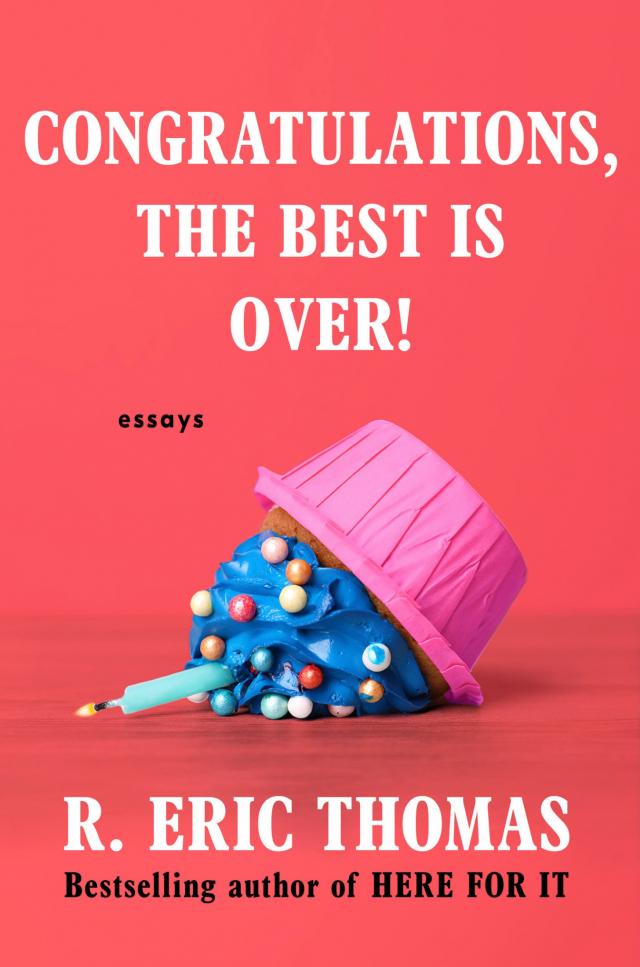
Title: Congratulations, the best is over! : essays / R. Eric Thomas.
Description: First edition. | New York: Ballantine Books, [2023]
Identifiers: LCCN 2023009188 (print) | LCCN 2023009189 (ebook) | ISBN 9780593496268 (hardcover) | ISBN 9780593496275 (ebook)
Subjects: LCSH: Thomas, R. Eric. | Authors, American—Biography. | African American gay men—Biography. | Middle age—Humor. | Baltimore (Md.)—Biography. | LCGFT: Essays. | Autobiographies.
Classification: LCC PS3620.H6375 Z46 2023 (print) | LCC PS3620.H6375 (ebook) | DDC 818/.603—dc23/eng/20230501
LC record available at https://lccn.loc.gov/2023009188
LC ebook record available at https://lccn.loc.gov/2023009189
Ebook ISBN 9780593496275
randomhousebooks.com
Book design by Diane Hobbing, adapted for ebook
Cover design: Rachel Ake Kuech
Cover image: Liudmila Chernetska/Getty Images
ep_prh_6.1_144556707_c0_r0
Contents
Cover
Title Page
Copyright
Epigraph
Introduction: The Middle
Part One: Homecoming
This Is Wudder
Maybe Going Back Again
Oh My, This Soup’s Delicious, Isn’t It?
The Greatest City in America
You Said You Outside, but You Ain’t That Outside
You Rock
Clap Until You Feel It
Break Room Cake Communion
Another Person in the Room
Part Two: Homegoing
Congratulations, the Best Is Over!
Jericho
Hostas Negotiator
Determined to Enjoy Myself
Soft Ground: An Interlude
The Invitation
God in the Machine
Rainbow Connection
It’s Called Hope
Dedication
Acknowledgments
By R. Eric Thomas
About the Author
_144556707_
Well, someone’s got to break the ice, and it might as well be me. I mean, I’m used to being a hostess, it’s part of my husband’s work. And it’s always difficult when a group of new friends meet together for the first time, to get acquainted. So, I’m perfectly prepared to start the ball rolling…. I mean, I…I have absolutely no idea what we’re doing here. Or what I’m doing here. Or what this place is about. But I am determined to enjoy myself.
—Mrs. Peacock, Clue
ANDY WARHOL: Why can’t it just be magic all the time?
JOAN DIDION: What.
—published in Interview magazine
Introduction: The Middle
I wanted a cupcake. I was in my late twenties and, all my other ambitions thwarted, I just wanted a cupcake. But you can’t make one cupcake. So I made a dozen cupcakes. Why not? I deserved a little treat!
It takes effort, but it’s not the hardest conceivable dessert. I wasn’t treating myself to a croquembouche. I’m the kind of person who always wants a complicated dessert—an éclair, a canelé, a perfect crème brûlée (really, anything with an accent over the “e”). But I’m not going to do all that. So I settled for a cupcake. A dozen cupcakes.
Like a lot of people in their twenties, I had kitchen supplies that would get the job done but weren’t quite the right thing. A misshapen plastic bowl, a spoon that was a little too big, an oven that was a little too small. I was in the process of saving up for a stand mixer, but it was very slow going because I had no money whatsoever, so I made the cupcakes and icing by hand.
At the end, the kitchen counter was covered in flour and buttercream smears and the sink was full of dishes, but I had my cupcake. It was all I wanted.
* * *
—
I was in a phase of life that was, in retrospect, typical of one’s late twenties—money troubles, underemployment, the dawning thought, Wait, is life a scam, lol? I’d moved to Philadelphia in 2005, following a dream of finding success in the city’s vibrant arts scene; now I was six years in and no closer to my goal. I was scrounging together money from odd jobs, then later as a legal assistant at a firm that was an hour away and barely netted me rent. I had had a friend breakup with my longtime roommate—it was my fault—and moved into a house with a gregarious guy I’d just met and his two cats, who were convinced I’d usurped their hanging-out room and who conducted Mission: Impossible–style break-ins at all hours of the day and night. The cats’ names were Cole Hamels and Chase Utley, after two Phillies players, but I knew I’d never remember that, so I redubbed them Jennifer Hudson and Susan Sarandon. Both Oscar winners!
When I came to the city, I wanted to write for a living, I wanted to find love, I wanted to make peace with myself after some failures in college, I wanted to feel hope. Now all I wanted was a cupcake. So I made a cupcake. And it made me feel better.
Then, I kept making cupcakes. Directionless and with a dwindling social circle, I was soon making cupcakes multiple times a week. For no one!
My roommate was a bodybuilder, so I just want you to imagine the psychological terrorism of having every surface in a kitchen covered by baked goods when you’re counting macros. But I was a man possessed. I tried out different flavors. Peanut butter icing on banana cakes. Strawberry icing on ginger cakes. Chocolate cakes with cherries in the center, topped with cream cheese icing. Rainbow Pride cupcakes that resulted in every dish in the kitchen being stained with dyes of different colors.
These were creative cupcakes, but they were not impressive cupcakes. Still, I kept making them. I made hundreds, perhaps thousands, of cupcakes. No one asked why. I don’t hold this against anyone. Why are you looking at cupcakes and asking why? What are you, a philosopher?
Besides, baking wasn’t a cry for help. I’ve done plenty of things before and since that are absolutely cries for help: dyeing my hair, abruptly moving to a different state, writing and publishing personal essays. But the cupcakes weren’t that. They were, like the name of a cute shop in a Lifetime holiday movie, Just Desserts. I was in an unhappy phase of life that I feared I would never get out of, but baking didn’t save me, either. Otherwise, this book would be called Knead, Pray, Love and have recipes in it and maybe there’d be two hands on the cover clapping in a cloud of flour. Oh, wouldn’t that be nice?! Wouldn’t that be lovely. Oh wow.
Anyway! There are no recipes in this book. If you want a recipe, google “cupcake recipes,” because this part, my cupcake days, is just about over.
I baked for a couple of years as the other wants in my life stagnated. But surrounded by my sea of baked goods, my life unchanged, my belly full, I wondered what I was supposed to do once the cake was finished.
* * *
—
As an aspiring artist, I was used to taking every one of my interests and entrusting them with my financial well-being, but I never wanted to turn the cupcakes into a moneymaking endeavor. I was not going to become a cupcake professional. I was happy making something just for the pleasure of doing it. Family members were giving me restaurant-size vanilla and specialty baking tins for Christmas and birthdays; cupcakes became “my thing,” but at the end of the day, it was a hobby. As I tried to make something of the rest of my life, I wondered if hobbies were a reflection of a deeper truth about the self or a diversion from it.
Throughout this period, my father would regularly come across articles about 401(k)s and constructing one’s five-year plan and send them to me, often on LinkedIn. Then I’d have to figure out what my LinkedIn password was, find my messages, and download an article my father had taken the time to scan in on his work computer. The PDFs would instruct me to map out an idea of what my future would look like, and I’d stare at them as if I was trying to decipher hieroglyphics. I knew what five-year plans were, but I didn’t know how to begin making one for myself.
One of the ways I understand my father is as a businessman. There are a lot of businesspeople in the world, usually in airports. They have important jobs that I can’t comprehend, and they take conference calls I can’t follow. They know what the plan is. My father had the title of manager at a succession of companies and was now general-managing a public market. I love business words: “arbitrage,” “circle back,” “Excel!” What fun! But I thought that business was a component of an ordered universe I wasn’t a part of.
Still, I read those LinkedIn messages with great interest. Not only were they talking about conceiving of myself outside my current circumstance, but they seemed to be just slightl
It said: “I see you. The future is coming. Keep going.”
The five-year plan was “hope.”
* * *
—
I made my way through hopeless years, one dozen cupcakes at a time. Eventually, I met someone, we moved in together, and he bought me a Vitamix, because I was all about juicing now. My cupcake days were over. I got new jobs; I started freelance writing on the side. My boyfriend and I broke up. I nearly drowned in sorrow and juice. A year later I wrote a one-man show about a search for God, a boyfriend, and baked goods. I took unglamorous production photos of me eating a cupcake, which I absolutely would not allow to be published today. In the audience, I met a white social-justice-seeking pastor named David. We got married a few weeks before the 2016 election, which was an emotional whiplash–inducing series of events. Two months later, I got laid off from my job but miraculously managed to secure a full-time position at ELLE.com. I went to visit their Manhattan offices for the first time and there were fancy cupcakes waiting. I ate half of one.
My cupcake days seemed so far behind me then. I knew who I was. I knew where I was going. I remembered my LinkedIn password. Life was going the way I hoped. And then everything changed. By 2017, I found myself living back in my hometown after twelve years away, a stranger to myself, a stranger in my marriage, unsure of what the plan was. I wanted to pull my new stand mixer out, but my doctor was like, “You’re getting too old to have all that sugar, babe.”
So, what now? What do you do when you find yourself in cupcake days again and you’re not in your twenties? What if you’re nearly forty? What if you’re sending a kid off to college? What if you’re about to retire? I wondered if I’d missed the part of life that I’d been working toward. And there’s a relief in that, I guess. You are freed from wanting something so badly and fearing that you won’t get it or won’t appreciate it or that you’ll lose it too quickly. You can find contentment. But I wasn’t content. And I wanted so much more than a cupcake.
Over the five years that followed, I would experience incredible highs that would transform me and crushing lows that would send me wandering into a wilderness. I’d change jobs, my husband and I would buy a house, we’d lose a parent, we’d search for community, all against the backdrop (and frequent foreground) of political upheaval and pandemic. None of this was in the plan.
But between the best days of life and the worst days of life, between what you thought your life would be and what it is, between two people, there is a vivid and strange expanse in the middle. This is the middle.
Part One
HOMECOMING
This Is Wudder
The appeal of the building was that it had an infinity pool and that it was situated next to the Jones Falls, a bucolic eighteen-mile stream that runs through Baltimore along I-83. Those were the things they were selling. The apartments were handsomely designed, carved out of the shell of an old sailcloth factory that later made model trains and dolls that were at least 40 percent haunted. It was an award-winning green-energy building that had preserved many of the original features, like huge wooden beams that crisscrossed throughout the floors. There was a “common room” in the middle of the third floor that had a computer workstation, a big TV, and a few couches for gathering.
“Imagine yourself watching the Super Bowl here while drinking a nice cold beer!” the leasing agent declared to me and my husband, David, when our tour reached the common room. And then she just stared at me as I desperately tried to force my brain to generate any of those images. “There’s also a gym you can use anytime, day or night,” she said.
“Please,” I replied, “I’m having an aneurysm.”
The selling points, however, were the pool, which was only about the size of two picnic tables but apparently went on infinitely, and the Falls, which attracted herons and geese and provided a peaceful view augmented by the dulcet sounds of highway traffic.
“I could be happy here,” I said to David, which is a deranged kind of promise but also just a statement of fact. It was 2017 and we were currently living in Philadelphia, where, as a matter of fact, I was incredibly happy. I hadn’t lived in Baltimore for going on thirteen years at that point. I’d hightailed it to New York for college, but after dropping out, I crash-landed back at my parents’ house. Those years in Baltimore had been hard. I waited tables at a comedy club humorlessly, I came out to myself and the world in lurching fits and starts, I accidentally got myself canceled writing for a local college’s newspaper. The usual catastrophic coming-of-age.
At the time, HBO was shooting the television series The Wire in my parents’ redlined neighborhood, which felt simultaneously glamorous and demoralizing. I put a placard outside my bedroom window that read “filming location for a modern American tragedy.” My parents had gone to great lengths to create a world of possibility in our house when I was growing up, but the outside world of the neighborhood was resolutely without hope. Abandoned by avaricious landlords and the elected officials supposedly representing it, the neighborhood may have been defined onscreen by the pervasive influence of drugs and violence, but the real story was of a people who were never afforded any options. While living there after college, I struggled to craft a better narrative for myself, let alone the city. Was such a thing even possible for me—a Black college dropout, a gay man whose conservative religious upbringing promised damnation, a failure?
Moving away had given me the chance to write another narrative, but it had also calcified my complicated feelings about my hometown into an active grudge. Callously, I used to quip, “I don’t want to move back to Baltimore even to be buried.” And while it feels silly to have a feud with a city for what are, largely, personal problems, quirks of temperament, and crises I created on my own with the help of structural oppression, I did frequently write emails to the mayor of Baltimore with the subject line “APOLOGIZE!”
But the mayor had yet to write back as I stood in a refurbished factory-turned-luxury-apartment building. I looked from my husband to the realtor to the sparkling water by the highway and considered starting a new chapter in a story I thought was finished. It is possible that I’ll be happy. Here.
* * *
—
I’d moved to Philadelphia on a whim that turned out to be a good idea in retrospect, which is the only way I plan. The first couple of years were just as hard as Baltimore in my early twenties had been, because, shockingly, riding two hours up I-95 did not bippity-boppity-boo me into some radically different person. But through trial and error, through pushing my boundaries, through the bippity-boppity of the passage of time, I found my people, and through them, I found a self that I liked.
Over the course of a decade and change, I had slowly and magically built a community, found artistic success, and met David, which are all promises they make to you in the Philadelphia constitution. The city motto is “Whiz Wit a Spouse,” I believe. But by the summer after our wedding, we were at a turning point. I’d been laid off from a job at a university but had been lucky enough to have my freelance job writing a humor column for ELLE.com turn into a full-time gig. My career was stable but completely remote. David, meanwhile, had graduated from therapy school (like school to be a therapist, not that thing I do where I sign up for a writing workshop and just talk about my problems the whole time). He’d earned his second master’s, his first being in divinity, but was having trouble finding a job as a pastor, which was his passion and his calling.






