

Final belongings, p.1
Final Belongings, page 1
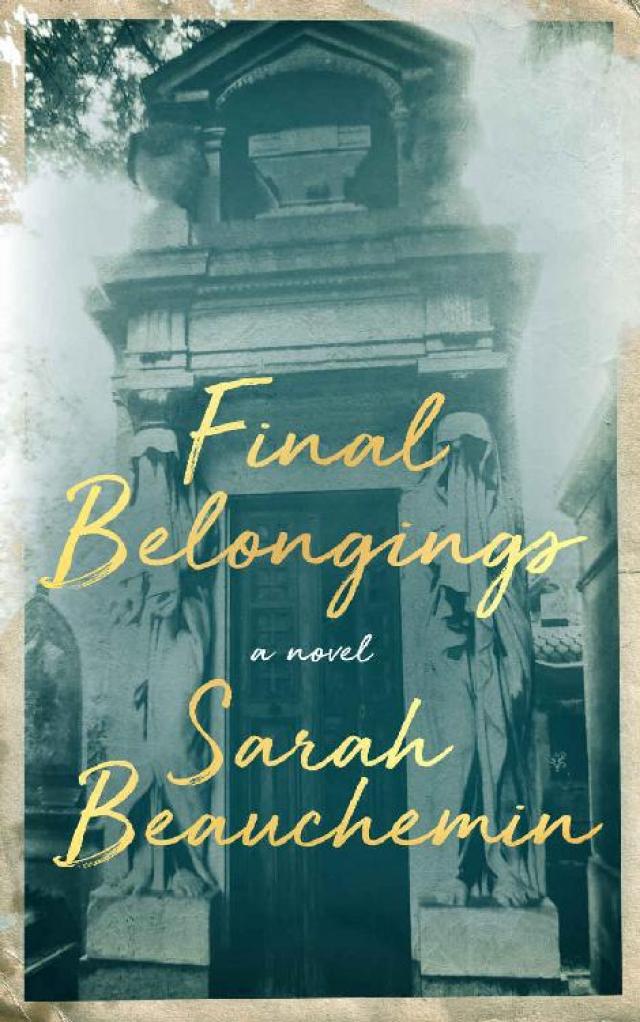


Copyright © 2022 Sarah Beauchemin
Final Belongings is a work of fiction. Any references to historical events, real people, or real places are used fictitiously. Other names, characters, places, and events are products of the author’s imagination, and any resemblance to actual events or places or persons, living or dead, is entirely coincidental.
All rights reserved. No part of this book may be used or reproduced in any manner whatsoever without express written permission of the publisher except in the case of brief quotations embodied in critical articles or reviews.
ISBN (eBook) 979-8-9865499-0-3
ISBN (Paperback) 979-8-9865499-1-0
ISBN (Hardback) 979-8-9865499-2-7
Cover Design by Damonza.com
For Bart
Contents
Chapter One
Chapter Two
Chapter Three
Chapter Four
Chapter Five
Chapter Six
Chapter Seven
Chapter Eight
Chapter Nine
Chapter Ten
Chapter Eleven
Chapter Twelve
Chapter Thirteen
Chapter Fourteen
Chapter Fifteen
Chapter Sixteen
Chapter Seventeen
Chapter Eighteen
Chapter Nineteen
Chapter Twenty
Chapter Twenty-One
Chapter Twenty-Two
Chapter Twenty-Three
Chapter Twenty-Four
Chapter Twenty-Five
Chapter Twenty-Six
Chapter Twenty-Seven
Chapter Twenty-Eight
Chapter Twenty-Nine
Chapter Thirty
Chapter Thirty-One
Chapter Thirty-Two
Chapter Thirty-Three
Chapter Thirty-Four
Chapter Thirty-Five
Chapter Thirty-Six
Chapter Thirty-Seven
Chapter Thirty-Eight
Chapter Thirty-Nine
Chapter Forty
Chapter One
My job interview is at one o’clock, so I need to start sobering up by noon. I glance at my phone. Eleven-thirty. There’s still time for another Bloody, as long as I cut the vodka back by half. Just a little something to take the edge off my nerves, to hone my focus. Like those business-class passengers I’d see on early flights when Matt and I used to travel. Important people doing important work. Sipping an icy screwdriver to temper their steaming coffee, their laptops open with DocuSigns and emails and Slack threads awaiting their decisions. If they can enjoy a morning bracer, why not me? Plus, I’m not even drunk right now. I’m just in that perfect warm zone where I feel alive again.
I roll back from the antique desk in our study, maneuvering around its titanic leg just in time before I stand up. After six months of bashing my knee almost daily on this walnut graduation gift from Mom, I finally learned my lesson. You’d think the regular dose of blinding pain would’ve been enough to spark a clever idea to write about. Or, really, any idea at all.
You’d think.
I go to the kitchen, yank open the freezer door, and unscrew the Grey Goose. The vodka clouds the tomato juice into plasma as I stir. Snippets of my old life stare at me, held fast under fridge magnets. There we are, Matt and me outside that retro ski lodge in Tahoe; sitting with plates scraped clean in that euphoric Anthony Bourdain recommendation in Thailand; tearing open our stocking gag gifts on Christmas morning. Matt’s eyes, clear and assured, fixed on me. The safety and warmth of that steady gaze.
But then I remember. My stomach lurches like it’s drowning in sea water. Briny, bitter cold. Boundless.
I whisk my drink off the countertop and into the living room where our stuff sits in respective piles on the floor—his and hers. This room, our entire home, was once my sanctuary. But now it’s just another place I can’t wait to escape. To where, though, I have no idea yet.
Was. Is there a more poisonous word? See, I’ve learned that the expanse between was and is is so much greater than I could’ve ever imagined. Think about the inevitable we all face: “I was young, now I’m old. I was beautiful, now I’m just another monochrome face in the background. I was in love, now I dread each time I hear the key turn in the lock.”
On the list of terminal illnesses, was ranks up there with the worst of them. That moment you realize you’ve moved from one state of being to the next without your permission. When you notice you’re a stranger in your own skin. It’s staggering, really. The unfairness of it all. If you’re lucky, it’ll smack you all at once. You won’t feel it slipping away little by little, like I did.
Downing the rest of my drink, I drop onto the West Elm sofa I decided I’m taking with me to my next abode, wherever that may be. I’ve only got two more weeks to find an apartment. So far, every option in my price range is roughly the size of a placemat and sits two feet from a roaring freeway. The damn couch probably won’t fit anyhow.
I sigh and let my eyes close. I just need a minute to rest. Before I know it, my phone trumpets from somewhere in the house. What time is it? Did I fall asleep? I prop myself up on my elbow, squinting and disoriented, cold with the creeping panic of something I’ve forgotten. Then it hits me—the job interview.
I leap up and run to the study, stabbing at my phone to silence the alarm while opening my laptop. Of course, it takes forever, and I curse the little rainbow spinning wheel to the fiery depths of hell. Scooting into my chair, I smooth my hair and swipe at my eyes, praying I can pass for a functioning adult. Maybe this guy will be just as casual as me.
To my dismay, an impeccable man in his fifties appears on screen with a tight smile. The room sways around me, and I realize that in addition to being late for the interview, I’m more drunk than I thought. For a second, I consider clicking off and going back to sleep. Would it really matter?
“Juliet?” he says.
“Hi, Scott, sorry I’m running behind.” I feed him the line about how it’s the weirdest thing; today technology just doesn’t want to work.
“No worries,” he says. “Let’s just dive in.”
I straighten. “Sure.”
He recaps the essence of the job, which is a remote position managing communications for a law firm marketing agency. And this is the least bleak of the three job interviews I managed to snag.
“Your resume’s solid, and so is your deck,” he says, referring to my work portfolio I sent him. “It looks like most of your stuff is from your time at Hummingbird, right? That’s a marketing agency?”
“Yes. They mainly do branding and content for tech start-ups. But other industries, too.”
“Mm. Any experience with law firms?” he says. You mean besides currently paying them thousands of dollars to finalize my divorce?
“Not directly, no. But I’m really well-versed in agency life. You know, switching gears fast, juggling multiple projects, interfacing with all types of clients. That kind of thing.”
Oh, God. I want to crucify myself for using interfacing. The only thing worse I could’ve said is synergizing. Better yet, synergizing industry verticals. I wish I could pinpoint exactly where, along my line of grave missteps, I turned into someone who talks like this.
“Great. We’re looking for that. Agency life isn’t for everyone, you know.”
“Right,” I say. I squash down the little voice screaming inside me that I belong to that very group of folks.
“Can I ask, then, why you left Hummingbird?”
I pause, hoping the heat in my face isn’t visible “Well, actually, I was laid off.”
“Really?” His eyebrows shoot to his manicured hairline. “I’d think there’d be no shortage of work when it comes to tech start-ups.” True, but it turns out there is a shortage of work for people who hate working for tech start-ups.
The last project I worked on before I got laid off was for this dating site that’s in beta called FoMo. Let me describe it like this: If you combined all the worst traits of humanity and put them into words, you’d have something that still stood head and shoulders above FoMo. Some twenty-year-old jackass in Palo Alto thought it would be awesome if an algorithm could complete your entire dating profile for you, just by uploading your photo. No need to waste thought describing oneself. If you have a certain kind of smile, for example, the program already knows you’re an extrovert. Or if you’ve got brown hair, you’re more likely to be sensitive. It actually worked most of the time. But that won’t cut it with venture capitalists. FoMo hired Hummingbird to help with content, and that’s where I came in. Day in and out, I wrote hollow copy that could fill in the program’s gaps so kids could get laid. Not exactly curing malaria, but damn close.
After a few more questions that illustrate just how mind-numbingly dull this job will be, Scott asks me if I have any of my own.
“Yes, about compensation,” I say, “the post just said ‘competitive.’ Can you give me a range?”
He tells me, and my gut turns to ice. I force my expression to stay neutral as I swallow an expletive. Way less than I made at Hummingbird, and definitely not enough to justify this position’s level of responsibility. Even worse, the abysmal pay is exactly in line with the other jobs I interviewed for. I’m doomed.
“Sounds good,” I horrify myself by saying. He says he’ll let me know about next steps, and we say our goodbyes.
I’ve barely had a minute to process this conversation with Scott when my phone rings. I throw it a weary g lance. Mom. Who else would it be? If you were to scroll through my call history, hers is the only name there. I know she’s only trying to help with her daily check-ins. But I have no energy to dodge questions about why and how my life is tanking, especially after our last blow-up where I told her that she, like all tenured history PhDs, is a pompous elitist. I’d pointed out how I would never have been that way, had I gotten my professorship.
The call ends and my phone screen goes black. Guilt scuttles across my chest. It’s fine, I’ll call her later. But as soon as I get out of my chair to refresh my drink, she rings again. Huffing, I grab the phone and hit decline. But there’s something else behind my adrenaline surge, an uncanny needling at the back of my mind. It’s not like her to call twice in a row. I stare at the phone. Nothing.
I move two steps toward the kitchen before the phone rings again. My hands tingle. I slowly turn back and pick it up.
“Juliet.” It’s a strangely flat voice that doesn’t belong to my mother, and I immediately know everything is wrong. It takes a second for the voice of Mom’s closest friend to register in my mind.
“Colette, is that you? What’s going on?” The words sound viscous and slow to me through the roaring that’s begun in my ears.
“I’m at your mom’s house,” she says. Then she’s going on about how she doesn’t know how to say this and asks if I’m sitting down and I hear walkie talkies in the background and all the other cliched, disembodied noises of despair fill my head until I think I’ll never hear anything else again.
And there it is, just like that: I was a daughter, and now I am not.
Chapter Two
“I can’t do this,” I say. “I thought I could, but I can’t.” Colette holds me tighter, her arm secure against my damp back. We’re standing in Mom’s hallway in front of the closed door to her study. It hasn’t been opened since the coroner removed her body four days ago.
By some grace of the universe, when Colette found Mom, they say she’d only had the stroke a few hours before. She hadn’t been alone very long. But she had been alone.
My mother died alone.
The thought tears through me, ripping open the protective sutures I tried in vain to stitch around my heart.
“You’re stronger than you think, Jules,” Colette says, pulling me to her. I try not to wince. I’m so limp, I feel like one more squeeze from her will send all my insides erupting through the top of my head. “I promise you can. We’ll do it together.”
“Oh, God,” I whisper through chattering teeth. The hallway bends around me. It can’t be possible for me to cry any more, but nonetheless, tears start to burn my retinas like acid. How can anyone live with the persistence of loss? How will I?
Colette turns me to face her. Her eyes are loving but firm. They pull me back to the present.
“Look. We’re just in and out today, okay?” she says. “Just to get the photos. We’ll deal with the rest of the stuff another time.”
Mom’s funeral is in three days. I’m running out of time to put together the celebration of life collage for her wake. I know the box of old family photos is in the study’s closet somewhere, among heaps of other stuff. There’s no choice. I have to go in.
“Okay,” I say, running a hand through my greasy hair. “Right. Okay. Just the photos.”
I grip the doorknob in my sweaty palm, turn, and push it open. My eyes clamp shut as Colette leads me stiffly over the threshold and a few paces into the room. What if Mom’s still in here? I think crazily. Lying dead on the floor, waiting to ask me why I didn’t come for her? A flash of our final phone conversation explodes in my mind. Me, exasperated: I can’t make it over today, Mom. I’ll let you know when it’s a good time. Now I have forever.
“You with me?” Colette says. With a feeble nod, I open my eyes.
Yes, Mom is still here. In a million different ways. The smell of warm chamomile lingers. I can hear her off-key humming over the steady click of the keyboard. I still see her, with furrowed brow and twisted mouth, massaging her eyeglass lenses with that fancy cloth that never got them all the way clean.
These are the things will haunt me—not her ghost, or any other. Just the loose ends, the fingerprint remains of a life cut short, answers that will never come.
Against my will, my gaze darts to the floor next to her desk where she was found. I’ve always thought that a person’s knees buckling in response to trauma was hyperbolic, but now here I am, dropping to the floor myself, my legs like two deflated accordions. Colette kneels beside me.
I let go, and so does she. An ungodly sound reverberates all around me, like a cat screaming in pain. It takes me a second to realize that I’m hearing my own elongated, choking sobs, so guttural I taste copper mixed with bile at the back of my throat. Saliva sprays from my mouth in ribbons and my lungs gasp in staccato breaths. And then I know just what I sound like, because it’s exactly what I am: a lost girl crying out for her mother.
Colette and I stay on the Persian rug like this for what feels like hours. The waning sun paints stripes on us through the slatted blinds, and dust particles dance all around. When I was little, Mom used to tell me this was fairy dust. Proof there was magic all around me. But I never saw it.
When we both begin to quiet, I raise my head and look around with eyes as hot and dry as the sands of Egypt. I’m in that wrung-out, post-grief state where exhaustion temporarily cauterizes emotion.
I force an empty laugh and blot at my face with my t-shirt.
“Should we look for those photos, then?” I say.
Colette’s eyes are steeped in sympathy behind those round Parisian rims. They’re offering me comfort I don’t deserve, and I look away, embarrassed.
“I think that’s a good next step,” she says, and we help each other to our feet. Her fingers are slender and dexterous and lovely, a reflection of a sane and disciplined life. I push my own rough hands with bitten-down fingernails into my back pockets. Then I take a deep, shuddering breath and shake out my limbs. Just in and out today. I can do this. Putting on my invisible blinders, I stride over to the closet and swing the door open.
At one point, it was actually a sizable walk-in. But now you can’t get more than three steps in before stubbing your toe on the old-school metal filing cabinets brimming with academic research or spraining your ankle on the monstrous books tiling the floor. How we’re ever going to be able to find that box with family photos is beyond me. My heart collapses. So much for getting in and out quickly.
Colette comes up behind me, blowing her nose. She’s carrying a tissue box she must’ve found somewhere and offers it to me. I thank her and take one, wiping at my snot-encrusted face.
“Wow,” she says, lifting her glasses and dabbing a Kleenex under her eyes. “This thing is packed. Any idea where we should start?”
“Those,” I say, pointing to the boxes lining the top shelf. If I remember right, that’s where they were the last time Mom and I looked through them ages ago. Reaching up, I wrestle down the first stack of boxes above my head. I catch a whiff of my underarms and grimace. When was my last shower? I honestly can’t remember if I’ve had one since I got the news about Mom.
Box after box comes down. I take a quick peek in each, then push them over to Colette, announcing their contents as I go. Receipts and paid bills. Folders of graded student papers from fifteen years ago. Even though none of this stuff is embarrassing, I feel a vague tug of shame as I expose these long-buried items to the light of day. I half expect them to cringe and wiggle away, back into the darkness and safety of the closet like worms.
“It’s gotta be one of these,” I say, before grabbing the next box, which is sagging with extraordinary weight. It tangles briefly in the overhead light’s pull chain and I groan.
“Careful, Juliet!” Colette says, the calm in her voice fracturing for the first time today. I maneuver it down over my head and drop it to the floor like an anchor, then straighten up and wipe my forehead. I open the tattered box’s cardboard flaps, then stop. Adrenaline floods my hands and feet.
“Found it,” I say. I move back so Colette can see for herself the stack of dusty framed photos and vinyl-bound family albums, thick as bibles. She peers in and raises her brows at me.
“Looks like the jackpot.”






