

Pileaus, p.1
Pileaus, page 1


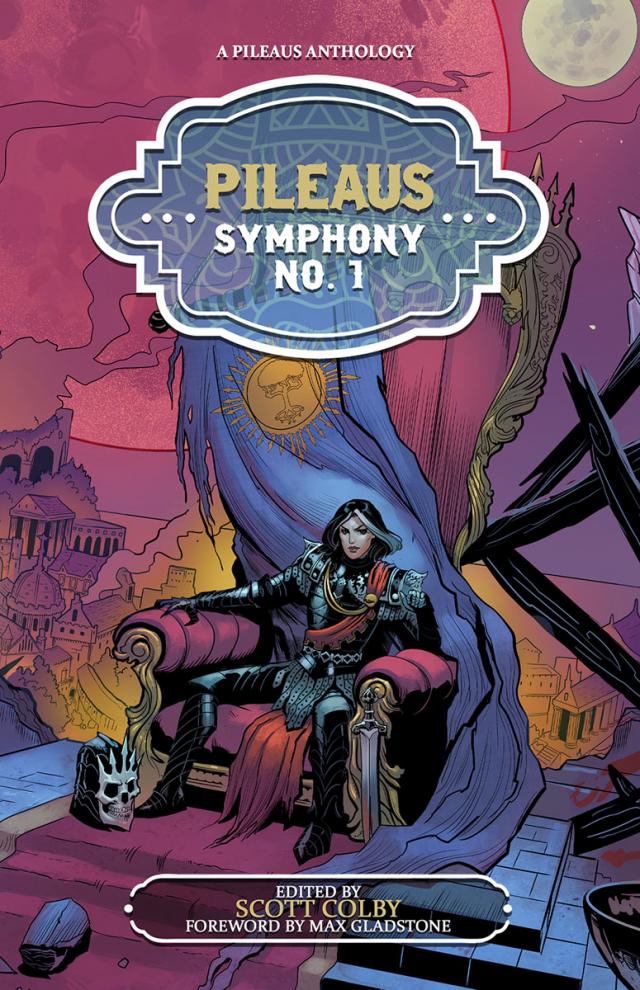
SYMPHONY NO.1: A PILEAUS ANTHOLOGY
Copyright © 2021 Outland Entertainment LLC. All rights reserved.
Published by Outland Entertainment LLC
3119 Gillham Road
Kansas City, MO 64109
Founder/Creative Director: Jeremy D. Mohler
Editor-in-Chief: Alana Joli Abbott
ISBN: 978-1-954255-19-7
EBOOK ISBN: 978-1-954255-20-3
Worldwide Rights
Created in the United States of America
Editor: Scott Colby
Cover Illustration: Chris Yarbrough
Cover Design: Jeremy D. Mohler
Interior Layout: Mikael Brodu
The characters and events portrayed in this book are fictitious or fictitious recreations of actual historical persons. Any similarity to real persons, living or dead, is coincidental and not intended by the authors unless otherwise specified. This book or any portion thereof may not be reproduced or used in any manner whatsoever without the express written permission of the publisher except for the use of brief quotations in a book review.
Printed and bound in the United States of America.
Visit outlandentertainment.com to see more, or follow us on our Facebook Page facebook.com/outlandentertainment/
— TABLE OF CONTENTS —
Introduction, by Max Gladstone
No Matter How You Hide Her, by Alana Joli Abbott
She’s Never Hard to Find, by Alana Joli Abbott
My Kind of Place, by Robert Lee Beers.
Debt, by Scott Colby.
Dreams and Nightmares, by Scott Colby
Ballasts of Magic, by by Gwendolyn N. Nix
Duty to Extremes, by Dylan Birtolo
Oceans of the Heart, by Emma Melville
Discord, by Emma Melville
Arest’s Tale, by Jeff Limke
Time and Tide, by Max Gladstone
Orchestration, by Max Gladstone
March, by Max Gladstone
Caesura, by Max Gladstone
Crescendo and Finale, by Max Gladstone
Traditions, by Andrew Schnider
Thistle, by Scott Colby
Welcome to the Dying Lands, Thistle, by Scott Colby
All Hail Lord Thistelonious!, by Scott Colby
End of the Line, by Scott Colby
The Trick to Tricking a Trickster, by Alana Joli Abbott
The Sound of Betrayal, by Emma Melville
Double Cross, by Scott Colby
Naming Place, by Emma Melville
A Day of Strangers, by Dylan Birtolo
Imber’s Ocean of Glass, by Scott Colby
Shadivengen, by Mark Adams
— INTRODUCTION —
Max Gladstone
We share stories.
When a joke gets us, we look for someone who hasn’t heard it before, someone to whom we can tell it. When a tale shapes us, we’re drawn to tell it again to others, or we tell new tales in response. We share books we love with the people we love. Myth cycles and legends gather this way, layer by layer: knights accumulate around King Arthur’s table like rings in a tree, as successive storytellers take up the legend, and with successive tellings the legend gains the intricate simplicity called elegance.
The process is a little more complicated now, in the early 21st century, than it used to be. Modern copyright regimes have changed the conditions under which stories are told, by giving one teller (or—more worrying, to my mind—one multinational corporation) the legal power to say what the “real” story is. Of course, writers have been asserting creative control over their work in one form or another for a long time—my favorite example is how dedicated Miguel de Cervantes is, throughout Part 2 of Don Quixote, to read for trash what we might now describe as a “fan-authored sequel” to Part 1. But if I want to write a story starring Raymond Chandler’s detective Phillip Marlowe, I can’t—barring the permission of the Chandler estate or the slow entry of the Marlowe stories into public domain.
There are a few possible responses to this challenge. One is the modern invention of the “subgenre”: I can write a story that’s practically a Phillip Marlowe story, or practically The Lord of the Rings, in terms of style, structure, affect architecture, as long as I don’t use any of the same names or plagiarize the literal text. Another strategy is fan fiction: write what you want to write, even if it stars Luke Skywalker and Captain Kirk, but don’t sell it in the general marketplace, and recognize that your work is unlikely to become part of the story that’s passed on in the mainstream culture.
One of my favorite responses to this pressure is the joint project. An idea comes together, a world, a concept—but it’s more than one person’s vision, one person’s story, and that’s the point. The initial creative impulse builds room for others to engage with and enlarge not just the fictional setting—the collection of things present in the world of the story—but its creative and emotional possibilities. Joint projects can have many different modes of organization and many different relationships to copyright, but when they do function, they create something uniquely shared and, as a result, uniquely welcoming to readers. Rather than a single tree growing outward ring by ring, you have a banyan, prop roots and vines spreading around and through.
Which brings us to Pileaus and the stories you’ll find in this volume. When I first encountered the world of Pileaus, I was struck by how much room it offered for invention, mystery, and strangeness. Joint fantasy worlds so often take their cues from Dungeons and Dragons, not necessarily in terms of their world building, but in terms of their main interaction metaphors—the things characters do on a moment to moment basis. They go on adventures. They hit spiky critters with sharp sticks. They cast spells and gather gold pieces to fund their next adventure. It’s a fun model, but it limits itself to certain kinds of stories.
Under the moons of Pileaus, music is magic, fae hunt violinists, and bards weave plots as well as spells. Empires tighten their grip and rebels resist, while in the dreamworld, faerie lords and ladies cavort and scheme. Certainly, there are adventurers here, as there are in real life. But just as striking to me are the people—a desperate musician, a half-fae child, a failed rebel, a skyship pilot haunted by a strange discordant song—trying to live, to find a place for themselves in a world that obeys fairy-tale logic more than the logic of adventure fantasy: a world in which the hero is not the hawk but the mouse, the small and clever and scared being trying to survive, to grow, to remember, to carry on, and, occasionally, to sing. A world, in that respect, not unlike our own.
Under a single author’s pen, no matter how expansive the initial vision, all these stories would tend to circle back around to a single coherent theme—even the wildest of us tends to feel the gravity of meaning and significance. But while the stories in this volume are guided by a unified editorial vision, Pileaus is flexible and mysterious enough to be shaped to its authors’ many interests and obsessions. It can be a hard-bitten barfight, it can be the lonely and the lost banding together against impossible odds, it can be a broken man desperate to make amends, it can be an explorer’s obsession. When I was first introduced to Pileaus, it felt like something I’d dreamed—and, rarer still, it felt like someplace big enough to dream in. A place, in short, to share.
Go slowly here. Pileaus is a world of multitudes—moons, species, curses, societies, magics, languages. It may help to follow a single thread, as when we listen to a single instrument in a symphony: a single character or concept or even author can be your compass. Music is an excellent starting place. Listen to the many forms of music, here—music as flight, as dream, revelation, music as vision, as drug, music as liberation and as an instrument of control. It twists, surprises, conceals, and reveals. And you might find yourself humming a few bars—or walking over to a friend with your headphones out: “Hey. You’ve got to hear this.”
These are old stories: not by the standards of stories, by which they were practically written yesterday, but by the standards of the internet world in which they took root and in which they have grown. The authors—including me—are older and we would hope wiser now than they were when they first dreamed these characters and wrote these words. But there’s a bright freshness to the work, of leaves not yet unfurled, of bright clear notes drawn from a new-strung fiddle. Hear it. Take it in. I hope you find something here to pass along.
— NO MATTER HOW YOU HIDE HER —
Alana Joli Abbott
Rhia shrugged further into her cloak. The moment the sun sank, the air turned cold, and she could see her breath hovering on the fog in the air.
“Fair Dilys, I saw smiling,” sang the girl behind her shoulder, breath catching much like Rhia’s had, but then dancing through the fog, almost in time with the notes. Rhia hummed quietly along, allowing the music to calm her, which was certainly what Dilys had intended. The girl’s hand slipped into Rhia’s below her cloak, and Rhia squeezed back.
Neither of them wanted to be here.
Rhia’s gaze cast about, trying to make the shapes in the fog become the people she’d been sent to identify. If they were people the Lady was interested in, Rhia was fairly sure she didn’t actually want to know them. It was safer to stay in the shadows, out of the Lady’s attention, but it was far too late for safety. If only she’d never caught the Lady’s eye—but it was too late for that, too. Now, she was what she was, and Dilys was with her.
“I see them,” Dilys said, the girl’s long and graceful arm extending through the fog, parting it like a shroud.
There were four shapes: three man-sh aped, though one was by far shorter than the others, and one woman shape that appeared to be carrying a light or lantern of some kind. Or perhaps she just glowed. Rhia fingered the beads on her bracelet, hanging into her palms beneath her cloak, and murmured a charm against evil.
“What do you see?” she asked quietly.
“Five, like fingers, the little one’s the thumb,” Dilys sing-songed. She gripped Rhia’s hand, starting to pull forward, but Rhia held back.
“Where’s the fifth?” she whispered, squinting against the fog.
Dilys’ arm dipped, and Rhia saw a small shape, no more than a child, between the tallest man and the glowing woman. But the fog shifted, and Rhia couldn’t make out the shape any more than she’d been able to when she first saw the group.
Then they stopped, the tall man giving instructions to the others, and they separated, forms drifting into abstraction as the fog covered them. Rhia bit the tip of her tongue, wanting to avoid the leader, because surely that was who the Lady was really interested in. Better to do the job simply, get enough information to please the Lady without actually complying. There was little enough she could do to rebel, not like the old days.
Dilys started off after the tall man, but Rhia yanked her back, and they followed the short man instead.
From his seat at the bar, Llew watched the short man enter, the smile on his face too broad for him to be up to any good. They’d been in town for a few days already, looking for something, and Llew was as curious as anyone to know what it might be.
No less because there were apparently folk willing to pay good coin for the information.
Beads clattered around his ears, tumbling forward with his hair, as he slammed his mug down, barking for another, despite the fact that he’d slopped most of the last one on the bar’s surface. The bartender—a Pilean import as much as his whiskey—took the pay without noticing, and Llew’s eyes wandered over the crowd. Few of them wore their colors anymore and not openly. The beads that had once decorated the hair of every man and woman there had now been relegated to smaller decoration—a bracelet here, an embroidery there. The people of Norrington were hiding amongst themselves, waiting. All except Llew, who’d never bothered to hide from anyone.
He ordered an additional second drink, the same slew that the short man with the axe had just ordered, and waited for the opportunity to offer it to the fellow. If habits from the previous night continued, the short man would begin telling stories of his own glorious exploits, which practically begged for people to buy him drinks. Llew would be ready.
And then Rhia came in, and his plans flitted off. The girl came in behind her, a waif of a thing in a too-big cloak, nearly thirteen but still slender as a reed. People rarely noticed Dilys in Rhia’s shadow, and Llew would hardly have seen her himself if he hadn’t known to look. But he’d learned that watching Rhia was a danger of its own, and so he kept his eyes locked on Dilys as Rhia let her cloak fall down around her shoulders, showcasing her slim figure and amplifying her curves through a gauzy dress in the Mana’Olai style.
Llew saw the way Dilys looked around, searching for familiar faces, waving with a grin as she saw people who recognized her and faltering when she noticed they were too busy staring at Rhia to make eye contact. Dilys almost resigned herself into a pout until she seemed to feel his gaze—Llew watching her so he could ignore the way that Rhia tossed her hair, the way she searched the room for her mark. Llew mirrored Dilys’ shy wave, and she giggled. Rhia’s face broke out into a dazzling smile that even Llew could not manage to ignore, and she approached the bar, Dilys in tow.
But they did not approach Llew—instead, they made their way toward the short man with the axe. Dilys tried to heft herself onto the too-tall barstool while Rhia touched the short man’s shoulder lightly. The bartender, enchanted by Rhia as much as the next man, called for music without her so much as asking.
Llew cursed as Rhia and the short man made their way out onto the dance floor.
“Bad words do not a good man make,” Dilys’ voice lilted at his side. He swallowed a second curse for not having noticed her sneaking up on him, then offered her a hand.
“What does the fair Dilys wish to drink this evening?” Llew asked quietly, darting his attention between the girl and the man he’d hoped to be the source of his coin.
“Apples and sky, all mixed together,” she giggled.
Llew reached out and touched the beads the girl had woven into her braid. They weren’t family colors—they were a myriad of blues and oranges and golds that echoed the hues in the girl’s eyes. “You’re too young for cider,” he warned her.
“You’re too old for wine,” she countered. “No matter how you hide her—”
“She’s never hard to find,” Llew intoned along with her. He barked at the bartender again, ordering the weakest cider in the house. It was cleaner and safer than the water had been since they’d lost Mydess to the Pilean invaders and hardly enough to give her more than a warm feeling in her stomach. Rhia would still kill him. “You be good, Dilys. Keep your eyes open.”
She wrapped her small hands around the cup, those blue and orange and gold eyes looking up at him, sparkling. “I see more when they’re closed.”
He pushed away from the bar, affecting a stumble, and Dilys giggled. It didn’t take long to spot Rhia and the short man on the dance floor—as usual, all attention was on Rhia, her tumble of auburn hair, her too-well-revealed figure. From the barmaids to the singer to the patrons, everyone watched her, some with animosity born of jealousy, others with unseemly interest. As Llew staggered through the crowd, spilling the drink he’d brought with him, he thought of what she’d looked like as a child, not so long ago, when they’d run messages together under the noses of the same Pilean soldiers who now policed them: mud-covered, freckled, lanky Rhia whose legs were too long for her body. If he could see that image, he could ignore whatever spell it was she wove around herself—true magic or not.
As she spun, laughing, in the short man’s arms, Llew lurched into them, sending all of them tumbling off balance. Llew’s mug flew and clattered on the ground.
“Sorry! Sorry!” Llew said, slowly and loudly enough to maintain his appearance. He offered a hand to help up the short man, but Rhia took his arm instead, pulling herself up too close to his chest to be coincidental.
“No trouble,” said the short man, making his way back out of the crowd, looking at both of them with suspicion. He patted his purse casually, quickly enough that a common passerby wouldn’t have noticed, and kept watching as he started back toward the bar.
“Aw, let me ‘least buy you a drink!” Llew tried, hiding his desperation, but Rhia had grabbed his hands, wrapping one around her waist as she closed the other around her fingers.
“Dance,” she commanded, and he did as he was told, watching his fortune walk away.
Rhia was tall enough that her mouth buzzed right next to his ear, her warm breath tickling as they swayed to the music. “Who are you working for this time?” she murmured.
“Freelance,” he grumbled back into her hair, remembering to stumble. She compensated, spinning away before pulling herself back into his arms. “You?”
She had the good manners to blanch. “I don’t know what you’re talking about.”
That meant she was working for her, Losa, the Black Queen, the one who had taken their freedom, their nation, out from under their feet. “I wish you didn’t,” Llew growled, pinching her fingers in his hand. The beads she wore on a bracelet, identifying her family line, her heritage, her place among their people, clattered against his wrist. “What does she want with them?”
He thought for a moment she wouldn’t answer. The tempo picked up, and he staggered through the steps again, but she held on, her chin resting on his shoulder despite his jerky motions.
“Same as everyone else, I imagine,” she whispered. “I only have to learn a little.”
There was an “or” hanging after the sentence, but both of them knew what the “or” meant. Rhia had had the bad luck of being noticed by the Black Queen and there was no way for her to avoid that scrutiny now.
“What if these are the type of people we need?” he said into a crescendo in the music. They both stamped along with the drum beat, he a bare moment off the heavy rhythm. “There’s something about them, Rhia. What if they could help us?”






