

Nowhereville, p.1
Nowhereville, page 1


Broken Eye Books is an independent press, here to bring you the odd, strange, and offbeat side of speculative fiction. Our stories tend to blend genres, highlighting the weird and blurring its boundaries with horror, sci-fi, and fantasy.
Support weird. Support indie.
brokeneyebooks.com
twitter.com/brokeneyebooks
facebook.com/brokeneyebooks
instagram.com/brokeneyebooks
patreon.com/brokeneyebooks
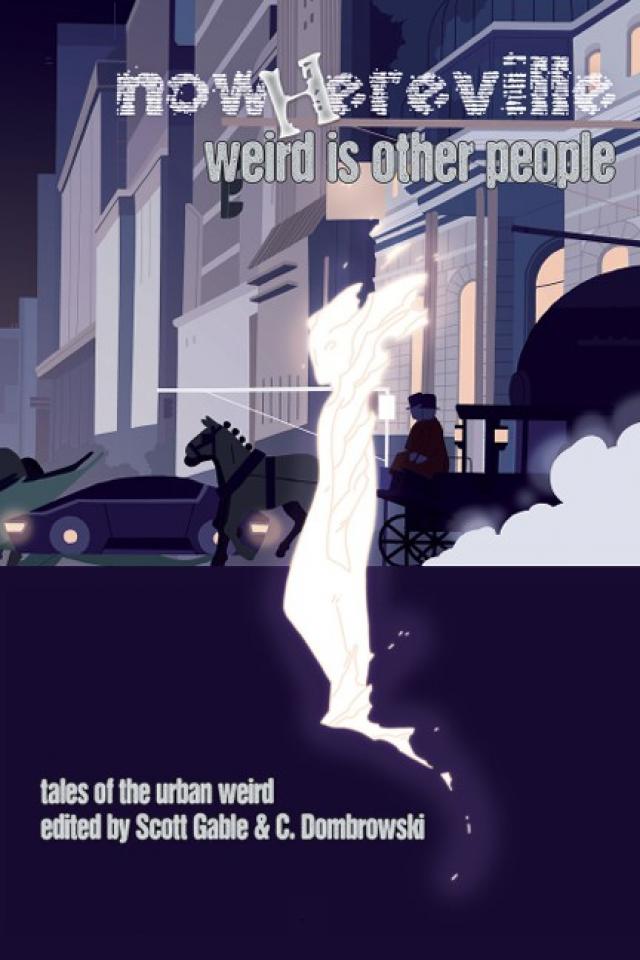
Nowhereville: Weird Is Other People
Published by Broken Eye Books
www.brokeneyebooks.com
All rights reserved.
Copyright © 2017–2019 Broken Eye Books and the authors.
Cover illustration by Meredith McClaren Meredith McClaren
Interior cartography by Oleg Dolya’s
Medieval Fantasy City Generator
Cover design by Scott Gable
Interior design by Scott Gable
Editing by Scott Gable and C. Dombrowski
Published in advance at Eyedolon (patreon.com/brokeneyebooks):
“Y” by Maura McHugh © 2017
“Patio Wing Monsters” by S.P. Miskowski © 2017
“Underglaze” by Craig Laurance Gidney © 2017
“A Name for Every Home” by Ramsey Campbell © 2018
“Urb Civ” by Kathe Koja © 2018
“Like Fleas on a Tired Dog’s Back” by Erica L. Satifka © 2018
“Walk Softly, Softly” by Nuzo Onoh © 2018
“The Vestige” by Lynda E. Rucker © 2018
“Night Doctors” by P. Djèlí Clark © 2018
“The Sister City” by Cody Goodfellow © 2018
“Tends to Zero” by Wole Talabi © 2019
“My Lying-Down Smiley Face” by Stephen Graham Jones © 2019
“Nolens Volens” by Mike Allen © 2019
“Vertices” by Jeffrey Thomas © 2019
“Luriberg-That-Was” by R.B. Lemberg © 2019
“The Chemical Bride” by Evan J. Peterson © 2019
“The Cure” by Tariro Ndoro © 2019
“Over/Under” by Leah Bobet © 2019
“Kleinsche Fläche of Four-Dimensional Redolence” by D.A. Xiaolin Spires © 2019
978-1-940372-47-1 (ebook)
978-1-940372-48-8 (trade paperback)
978-1-940372-49-5 (hardcover)
All characters and events in this book are fictional.
Any resemblance to persons living or dead is coincidental.
Table of Contents
Introduction: Toward a Weirder Tomorrow
Scott Gable
Walk Softly, Softly
Nuzo Onoh
Y
Maura McHugh
Night Doctors
P. Djèlí Clark
The Chemical Bride
Evan J. Peterson
Patio Wing Monsters
S.P. Miskowski
Underglaze
Craig Laurance Gidney
The Vestige
Lynda E. Rucker
The Cure
Tariro Ndoro
Kleinsche Fläche of Four-Dimensional Redolence
D.A. Xiaolin Spires
Nolens Volens
Mike Allen
Vertices
Jeffrey Thomas
Like Fleas on a Tired Dog’s Back
Erica L. Satifka
Urb Civ
Kathe Koja
Over/Under
Leah Bobet
A Name For Every Home
Ramsey Campbell
Tends to Zero
Wole Talabi
My Lying-Down Smiley Face
Stephen Graham Jones
Luriberg-That-Was
R.B. Lemberg
The Sister City
Cody Goodfellow
Introduction:
Toward a Weirder Tomorrow
Scott Gable
Between the Impossible of fantasy and the Inevitable (or at least Very Plausible Given Our Current Understanding) of science fiction exists the Maybe state of the weird. Simply put, weird fiction is the unknown. It lies between the real and the unreal, bringing our fear and ecstasy to life as we’re confronted by what we don’t understand.
If one could map all the stories ever told and yet to be told on a vast theoretical, multidimensional architecture, how might that look? Imagine each dimension, ticked off by different measures and serving as axes for plotting stories on this vast landscape. For the purposes at hand, we’re only interested in the portion relating to speculative fiction, so let’s spin the dials and shift our gaze through the appropriate porthole—
There! That particular spectacular and shifting lobe contains all of speculative fiction.
Charting the Weird
If one were to attempt to map speculation, at one end might lie fantasy while at the other science fiction. And caught in between is the weird.
Fantasy represents the impossible, at its core. These are the stories presenting pasts that have already happened (but differently) and the stories relying on elements that the consensus has deemed impossible (see also magic and dragons, such that while perhaps there is indeed more to understand about Universe, there is nothing substantive pointing toward it ever actually happening). These are the tales, whether heroic or dark, that don’t try to replicate our reality in every detail but that create worlds beholden only to their own internal logic, either from whole cloth or by reweaving the existing fabric of history (whether baldly or subtly).
Science fiction, on the other end, represents that which is inevitable, that which is perfectly likely, and even that which might very well happen to us as a species at some point in the future maybe—at least based on how we understand ourselves and Universe here and now. At its core, it is an extrapolation of our current reality, building social and technological advances or curtailments as befits the time of the writing. It is all of our possible futures based on our current understanding.
The weird (now that we’ve set a foundation) falls in between those prior two giants’ extremes. It is more proximal to our current state of being. It is our unknown, us trying to give name and shape to the darkness and to the ecstatic—to that which we don’t understand. It is often labeled as “supernatural” or “weird science,” depending on which side of the scale it tips, toward fantasy or toward science fiction. Compared to fantasy, it is anchored more firmly in the known: rather than rewriting all that exists, it instead merely pokes holes and pulls strings, tearing down or building up, layering upon the known. (Supernatural horror and folk horror and fabulism are some weird subgenres that often tilt toward fantasy.) Compared to science fiction, weird fiction is less certain. It relies on established principles, on a “science” and “nature,” that while perhaps imagined they have no accepted model. (Slipstream and “soft” science fiction are often the more science fiction–leaning of weird tales, exploring themes of death, dreams, psychic abilities (even time travel and artificial life can be weird adjacent)—the very nature of reality—and similar realms where science’s final word quite possibly hasn’t yet been said.)
Now, back to our massive map! It is comprised of axes, each a continuum of some quality, each further expandable into its own multidimensional spectrum as needed. But the three such measures of a story that might be most helpful now are proximity (or time), realism, and emotion.
Proximity is simply the past-present-future of the story, and this measures how close the reader is to the narrative in spacetime. Does it take place in a projected future or a derived past, or is it relaxing into a present-day approximation?
Realism is how far the fiction deviates from consensus reality. (The zero point here is our consensus world—this is realistic fiction and not speculative at all—and the opposite extreme is absurdism, or bizarro fiction.) So to what extent does a story speculate? Is there only a touch of the unreal painted on an otherwise “healthy” reality (as in magical realism), does it enter the surreal, or maybe sail on clear to the absurd?
Proximity and realism generally represent the setting of a story, the time and place and culture. But you still need to add in the plot and tension and mood, so there’s a third axis: emotion. This now makes such modes as horror, comedy, slice of life, and romance possible (all of which only intersect with speculative fiction some of the time, though they are free to intermingle with all speculative genres). To counter the idea that weird fiction and horror are interchangeable, key takeaways here are that 1) weird is not solely horror (just as horror is not solely weird) and 2) horror need not be considered separate from science fiction and fantasy; science fiction horror and fantasy horror and weird horror are all perfectly valid.
I suggest here that all of speculative fiction could be measured on the space defined by proximity, realism, and emotion. We could certainly refine this by unpacking the axes further and even adding more dimensions, but at the core, this feels a good approximation of speculation. And it is independent of style (existing anywhere from literary to pop).
Weird fiction encompasses the stories that take place in the realms between science fiction and fantasy, between non-speculative fiction and bizarro—between its borders with other genres. And these frontiers are evershifting. The weird sits in an “uncanny valley,” or rather an “uncanny sea,” of speculation, snug between impossibility and certitude, realism and absurdity.
In Weird Times
Perhaps more than other genres, weird fiction is very much a function of the era in which it is written. A given fantasy’s probably never going to stop being fantasy. Science fiction, of course, changes as we shuffle inexorably forward in spacetime, relying on our current knowns, occasionally becoming dated subgenres of itself (such as steampunk and cyberpunk) and celebrated on their own merits (and perhaps becoming more fantastical in their continuation). Weird fiction, however, relies on our current unknown, on the fears and desires of a people, probing the accumulated questions and assumptions of an age. It is a speculative lens of its time.
By way of illustration, I’ll invoke religion and folklore. Religion exalts the divine, building on the visions of its believers. It is real to the faithful, even if untouchable to scientific inquiry and unassailable to otherwise-believers. Likewise, folklore guards against the tribulations of an everyday life under constant scrutiny of ever-present supernatural malice and whimsy, circumstance proving causality in the face of need. My point for bringing this up is that these tales tend to slip into fantasy from our modern vantage: Gilgamesh no longer holds the same deific significance, the fair folk no longer curdle our milk in real time. But myth and folklore were all too real to people at one time, or rather all too weird.
We revel in the ecstasy! Religion never dies, so there will always be a weird space for the ecstatic. Tales of the Greek pantheon may never again reach outside the bounds of fantasy, but there are more than enough religious experiences, whether modern or fictional, to feed the emerging weird.
We brave the unknown! Eventually our fears get turned over, mulch for a new generation, but the bogeymen just change, again and again. They always change: demons and devils and faeries, witches and werewolves, vampires and ghosts, aliens and their gods. There’s always a new monster of the era.
What we now view as fantastical may have once been just the other side of the darkness, just the other side of the known world. Those earliest tales would have fit right at home with our current estimation of the weird. The mythic and the fey are to the weird as steampunk is to science fiction—they are the “old weird,” the weird of a different era. As time moves on, our weird drifts with it. The words may not change, but how they reflect our relationship with the world certainly does.
But then we also, since those early days, started questioning reality itself. The previous examples illustrated the more supernatural side of the weird, but in later narrative, there emerged a more scientific bent. If not earlier, then at least with Frankenstein, we saw scientific inquiry rise to high weirdness. And though we’ve come far, there’s still much we don’t know about Universe, so there’s more than enough fanciful conjecture and uncertain outcomes to fuel all the weird science of our dreams and keep us always twirling into the future weird.
All this is to say that weird fiction is very much reliant on our perspective. What was once weird is no longer. What is now weird may not always be. And who can tell what tomorrow’s weird holds. But let’s find out!
Nowhereville: Weird Is Other People
And that brings us to the book at hand. Nowhereville: Weird Is Other People contains nineteen original tales of urban weird fiction. These are the tales of the high weirdness inherent in clusters of people, in people interacting with others.
We cut right to the quick with the targeted, citywide body horror of Nuzo Onoh’s “Walk Softly, Softly.” From there, we zoom the microscope in on some very personal apocalypses with Maura McHugh’s “Y” and P. Djèlí Clark’s “Night Doctors,” dripping with agency and even popping back to 1937 America in the latter. Following that is a string of quiet personal horror and slice-of-life tales, focusing more on interpersonal weirdness, the weirdness that we impose upon ourselves and others, before we bounce into some tales of future weird landscapes. The last third of the book tends to intermix the personal with the sprawl of urban life until we send you back to your home reality with the final course of R.B. Lemberg’s “Luriberg-That-Was” and Cody Goodfellow’s “The Sister City”—both spiraling the reader through potent fabulist-surreal landscapes.
So that you can think on what you’ve done.
Many of these tales are dark, but as I’ve suggested above, it’s not my intent to provide you with just a horror fiction anthology. There are horror stories in here, absolutely, of varying degrees. This is, though, an exercise in weird fiction, intentionally drawing from the various shores of weirdness, from the Uncanny Sea, to explore all that might entail.
(The stories herein were first published to our Patreon website, Eyedolon, over the previous couple of years. Going forward, similar such anthologies will be collected in the same year as the stories’ online publication.)
Stay weird. Read books. Repeat.
September 18, 2019
(published in part to Eyedolon in 2018)
Scott Gable
Walk Softly, Softly
Nuzo Onoh
Obi’s sleep was interrupted by a burning urge to piss. The pressure in his groin was so great that he feared an embarrassing accident before he made it to the toilet across the corridor. His hand reached up to the light switch as he rushed toward the shut door of the toilet. The dusty bulb overhead flooded the dark corridor with a sickly yellow glow as he pushed open the rickety wooden door of the communal bathroom.
Earlier that evening, he’d gone overboard at the popular establishment Karma, Madam Joy’s secret brothel, bingeing on the icy palm wine offered by the fat woman till his stomach could hold no more. The result had been the usual violence that accompanied the poison in his bloodstream. By the time he was done with his prostitute, her own mother would have struggled to recognize the battered features of the screaming girl. Madam Joy had thrown him out, threatening to ban him for good from her house of pleasure.
Obi had stumbled out of the bar, cursing, punching, and spitting at some of the waitresses within his vicinity. Their angry screams followed him out to the street where he’d boarded the three-wheeled keke napep to his bedsit in the decrepit building located in the notorious slum Nike, a drug-infested area of the city, boasting robbers, kidnappers, murderers, and witch doctors as residents. Karma was just a mile away. On a good night, he would walk his way home, just as any other twenty-something, healthy, young man would. But on binge nights, he rode the bright yellow keke napep.
As he got out of the keke napep, he’d felt a sudden chill descend over him. It attacked him in waves, layering his skin with goose pimples and bringing an inexplicable dread to his heart. He shook his head vigorously, shouting out a loud greeting to some familiar figures, loitering neighbours hugging the railings of the balcony above his second-floor place. Their mocking laughter followed him into the building, together with someone else who walked silently behind him. Obi didn’t know who it was that had followed him into the building, didn’t really care to know either. Save for the person’s massive black shadow that waved before him, obliterating his own like a total eclipse, he wouldn’t even have known that someone else followed him up the stairs. The shadow seemed to grow, swell, spread across the uneven concrete like a solid black river.
That was when an uncomfortable sensation pierced through the drunken fog clouding his mind. The chill was back, this time with a vengeance. Obi felt the chattering of his teeth as his body trembled with a mixture of cold and terror. It was a terror that hit him without warning, a fear that came from the sudden awareness that he heard no footsteps behind him, felt no human presence with him despite the evidence of the dense shadow. His heart began to beat, pound with the thunder of a hundred war drums. He stopped midway up the staircase and turned.
He was alone. No one followed him. He swerved and stared at the solid black shadow that flowed upward like a blanket of tar, hugging the uneven angles of the stairs. He raised his arms and waved them frantically. The black shadow remained still, masking his own into invisibility. Obi began to run, race up the stairs in an attempt to overtake his dark companion. The black shadow raced with him, toyed with him, flowing first to his right and then to his left, before rushing ahead of him along the long narrow corridor that led to his bedsit. Obi saw it flow underneath the gap of his locked door as he fumbled for the room key in his pocket. His mind, cleared of its alcohol poison, pondered over the phenomenon. Was he hallucinating from his binge? Had the bitch at the brothel spiked his drinks with some ganja to knock him out before robbing him? Was it his own shadow after all rather than some terrifying entity his muddled mind had conjured? There was only one way to find out.






